
What Hard Money vs. Conventional Financing Actually Costs on a Value-Add Multifamily Deal in 2026: Full Rate and Fee Breakdown
What Does Hard Money vs Conventional Financing Cost on Value-Add Multifamily in 2026
Published August 27, 2026 · Updated August 27, 2026
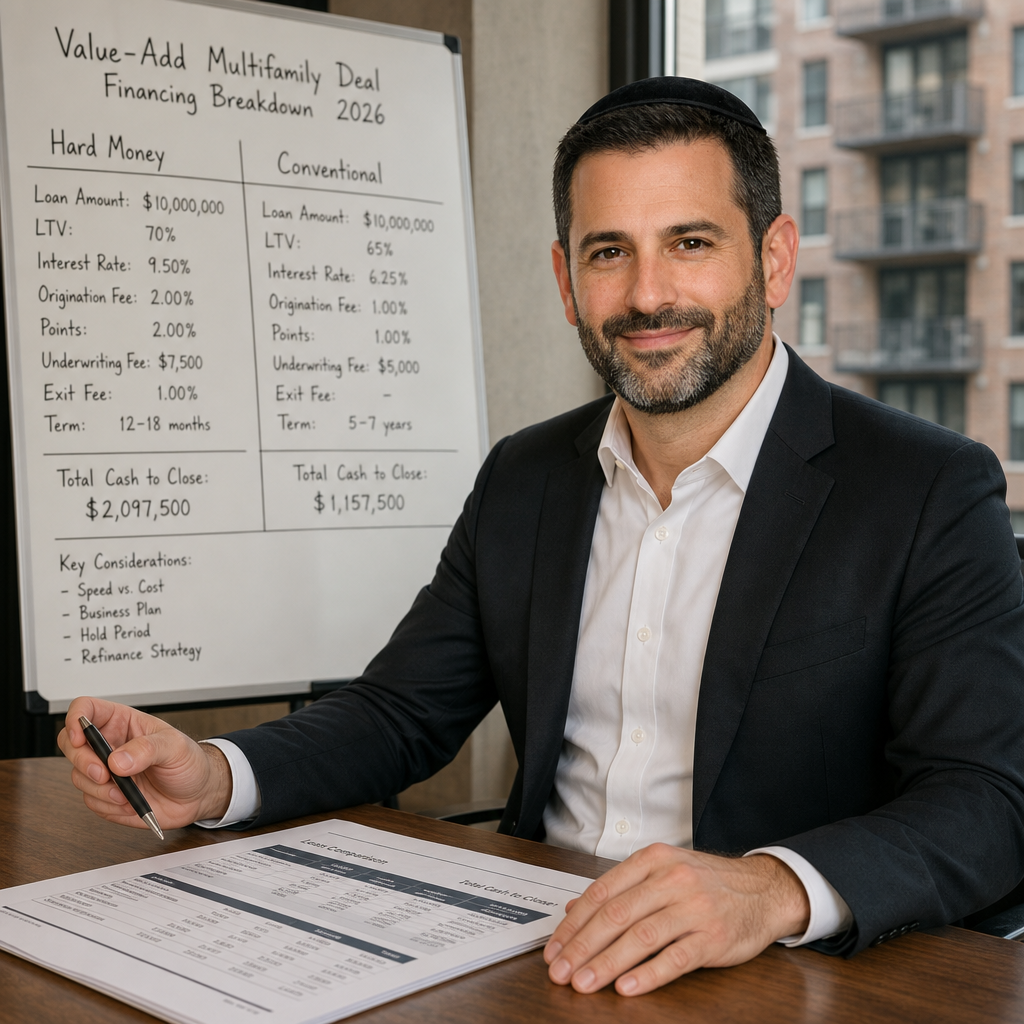
What does hard money vs conventional financing cost on value add multifamily in 2026 comes down to two very different math problems: hard money bridge loans typically run 9.5% to 12.75% in interest plus 1.5 to 3 points, while conventional agency debt from Fannie Mae or Freddie Mac typically prices at 6.10% to 7.65% plus 0.5 to 1 point, before reserves and reporting requirements even enter the picture. Neither number tells the whole story on its own, and that’s the part most breakdowns skip.
At-a-Glance Pricing Table
What Drives the Price
Worked Examples
Hidden Costs to Watch
How to Save Without Cutting Leverage
Our Take After Years Underwriting These Deals
FAQ
- Hard money bridge loans for value-add multifamily typically price at 9.5% to 12.75% interest plus 1.5 to 3 origination points in 2026.
- Conventional agency debt through Fannie Mae or the Freddie Mac Small Balance Loan program typically prices at 6.10% to 7.65% plus 0.5 to 1 point.
- Hard money closings typically run 10 to 21 days. Agency loan closings typically run 45 to 75 days.
- A typical $1.86 million hard money bridge loan carries $28,000 to $56,000 in points alone, before a dollar of interest accrues.
- Agency loans usually require a Debt Service Coverage Ratio of 1.20x to 1.25x that most hard money bridge lenders don’t enforce at all.
- Extension fees on hard money bridge loans typically run 0.25% to 0.5% of the loan balance per six-month extension.
If you’re a sponsor underwriting a value-add deal this year, deciding between a private lender who can close in two weeks and an agency correspondent who wants a stabilized rent roll first, the numbers below are the ones that actually move your return. This is not a comparison for someone weighing whether to buy the property at all. It’s for someone who already has the deal and needs to know what the money underneath it really costs.
At-a-Glance Pricing: What Hard Money vs Conventional Financing Costs in 2026
The table below lays out typical category-norm ranges for each cost line on a value-add multifamily deal in 2026. These are illustrative ranges based on how the market is currently pricing, not a quote from any single lender.
| Cost Item | Hard Money Bridge Loan | Conventional / Agency Loan |
|---|---|---|
| Interest rate | 9.5% – 12.75% | 6.10% – 7.65% |
| Origination points | 1.5 – 3 points | 0.5 – 1 point |
| Loan term | 12 – 24 months | 5 – 10 years, 30-yr amortization |
| Typical leverage | 75% – 85% loan-to-cost | 65% – 75% loan-to-value |
| Closing timeline | 10 – 21 days | 45 – 75 days |
| Appraisal fee | $2,800 – $4,500 | $3,500 – $6,000 |
| PCA + Phase I environmental | $2,500 – $5,000 combined | $4,000 – $8,000 combined |
| Prepayment / exit cost | 0% – 1% exit fee, often none | Yield maintenance or defeasance, 2% – 5% equivalent |
| Extension / assumption fee | 0.25% – 0.5% per 6-month extension | 0.5% – 1% loan assumption fee |
| DSCR requirement | Often none, asset-based | 1.20x – 1.25x minimum |
What Drives the Price
Rate sheets look uniform until you actually apply for a value-add multifamily loan. Five factors move the price more than anything else, and each one has a real dollar figure attached.
Leverage requested. Every 5% of loan-to-cost you push above the 75% mark on a hard money bridge typically adds 50 to 100 basis points to the quoted rate. Ask for 85% LTC instead of 75% and you can expect to pay meaningfully more for it.
Sponsor track record. A first-time value-add sponsor often sees 0.5 to 1.5 points higher origination than a repeat borrower with completed rehab projects behind them. Lenders price experience because it’s the single best predictor of a rehab budget staying on budget.
Rehab scope. A heavy rehab above roughly $25,000 per unit tends to push a hard money rate to the top of its range, and it stacks draw inspection fees of $150 to $300 per draw on top. A light cosmetic rehab under $8,000 a unit usually prices closer to the bottom of the range.
Occupancy at closing. Below roughly 75% physical occupancy, most agency lenders decline outright or push you into a bridge-to-agency structure, which means paying two sets of closing costs, typically $15,000 to $25,000 extra, instead of one.
Index movement. Agency loans price off the 10-year Treasury or SOFR swap spread. A 25 basis point move in the underlying index between application and rate lock moves your quoted rate by roughly the same amount, which on a $2 million loan is real money over a 10-year term.
“The fee schedule is where deals actually get won or lost, not the headline rate. Honestly, I didn’t fully appreciate that until I laid a hard money term sheet and an agency term sheet side by side, line by line, and watched the totals converge in a way the interest rate alone never suggested.”— David Stern Team
Worked Examples
These are typical, illustrative scenarios built from category-norm pricing, not a record of a completed transaction. The point is to show the actual math, not to promise a return.
Example 1: Hard Money Bridge on a Typical 24-Unit Value-Add Deal
A typical 24-unit, late-1980s garden-style complex trades at $1,950,000 with a $380,000 rehab budget, roughly $15,833 a unit for new flooring, kitchens, and exterior paint. Total project cost is $2,330,000. A hard money lender offers 80% loan-to-cost, or $1,864,000. At a 10.75% rate and 2 points origination, that’s $37,280 in points alone. Add a $1,850 legal and doc fee, a $3,400 appraisal, a $2,200 Phase I environmental report, and five construction draws at $225 each ($1,125), and total closing costs land around $45,855, about 2.46% of the loan amount before any interest accrues. Interest-only payments at 10.75% run $16,698 a month, roughly $200,376 over a 12-month hold.
Example 2: Conventional Agency Refinance After Stabilization
Take that same 24-unit property after rehab, now at 92% occupancy and appraised at $2,950,000. A Freddie Mac Small Balance Loan at 70% loan-to-value produces a $2,065,000 loan. At a 6.85% fixed rate and 1 point origination, that’s $20,650. Add a $4,800 appraisal, a $2,600 property condition assessment, and a $2,100 Phase I, and total upfront costs run about $30,150, roughly 1.46% of the loan amount. Amortized over 30 years on a 10-year term, monthly principal and interest lands near $13,540, lower than the hard money interest-only payment above and building equity through amortization on top of it.
Example 3: Total Cost Over an 18-Month Hold, Bridge-to-Agency vs Pure Hard Money
This is where the math gets interesting, and it’s the part most rate-comparison articles skip entirely. Run the deal above as pure hard money for a full 18-month hold: 18 months of interest at $16,698 is $300,564, plus $45,855 in original closing costs, plus one 6-month extension fee at 0.375% of $1,864,000, or $6,990. Total financing cost: $353,409. Now run it as bridge-to-agency, refinancing at month 9: nine months of hard money interest is $150,282, plus the $45,855 in bridge closing costs, plus $30,150 in agency refinance costs, plus nine months of agency debt service at $13,540, or $121,860. Total: $348,147. The two paths land within about $5,000 of each other over 18 months. The variable that actually decides the winner isn’t the rate spread, it’s how fast the property actually stabilizes.
A typical value-add multifamily bridge loan carries roughly 2.5% of the loan amount in upfront costs, while an agency takeout typically runs closer to 1.5%. Over an 18-month hold, a bridge-to-agency strategy and a pure hard money hold can land within a few thousand dollars of each other once you account for interest, points, and refinance costs together.
How to Save Without Cutting Quality
Get three hard money quotes and one agency correspondent quote before you sign anything
Points alone can vary 1 to 1.5 points between lenders like Kiavi, Roc Capital, or Lima One Capital for the same deal. On a $1.86 million loan, that’s a $18,600 to $27,900 swing before rate even enters the discussion.
Right-size the draw schedule
Fewer, larger draws instead of many small ones can cut inspection fees by $600 to $900 across a typical 24-unit rehab. Talk to your lender about combining draws before the rehab starts, not after the third invoice arrives.
Lock the agency rate the moment the PCA and appraisal are done
A 0.5% to 1% rate lock deposit protects you from index moves during the 45 to 75 day underwriting window. Waiting to lock because you’re hoping rates drop is how sponsors get caught by a 25 basis point move going the wrong direction.
Price the extension option at closing, not at month 11
Negotiating a pre-priced extension when the term sheet is signed typically costs less than renegotiating one under pressure with a rehab running behind and a lender who knows you have no leverage left.
I run the initial numbers on every one of these structures through 8ight before I ever get on the phone with a lender, mostly so the conversation starts from a real number instead of a guess. It doesn’t replace underwriting. It just keeps the first call honest. You can also work through your own value-add deal math before you approach either type of lender, and review our hard money lending breakdown for how draw schedules typically get structured.
Our Take After Years Underwriting Value-Add Multifamily Deals
Sponsors overweight the headline interest rate almost every time. A 200 basis point gap between hard money and agency debt sounds enormous on paper. On a 12 to 18 month hold, once you net out speed to close, the ability to buy a deal a conventional lender wouldn’t touch at 60% occupancy, and the points structure on each side, that gap shrinks fast. It doesn’t disappear. It shrinks.
What actually matters is whether your rehab timeline is realistic. That sounds obvious. It isn’t. Most cost overruns I see modeled in a typical pro forma come from an aggressive rehab schedule that assumes zero delays, zero permit hiccups, zero contractor no-shows. Stretch a 6-month rehab to 9 months on a hard money bridge and you’ve just added another $50,000 in interest to a deal that penciled fine on paper. Build slack into the schedule before you build slack into the budget.
The one thing I’d tell a friend underwriting their first value-add deal in 2026: price the exit before you price the entry. Know what a Freddie Mac SBL or Fannie Mae takeout looks like at your projected stabilized rent roll before you sign a bridge term sheet. And this is how I look at deals, not investment advice. Every property, every lender, and every rehab budget is different, and nothing here should be read as a promise about what your specific deal will return.
FAQ
How much does hard money cost compared to conventional financing on a value-add multifamily deal in 2026?
In 2026, hard money bridge loans for value-add multifamily typically price at 9.5% to 12.75% interest plus 1.5 to 3 points, while conventional agency loans through Fannie Mae or Freddie Mac typically price at 6.10% to 7.65% plus 0.5 to 1 point. The real cost gap narrows once you factor in speed to close and how quickly the property stabilizes.
What is the typical interest rate spread between hard money and agency debt in 2026?
The spread between hard money and agency debt typically runs 300 to 500 basis points in 2026, tighter than the 500 to 700 basis point spread common a few years back as private credit competition increased. That spread compresses further once a property stabilizes and refinances into permanent agency debt.
Are there prepayment penalties on hard money bridge loans?
Most hard money bridge loans carry little or no prepayment penalty, though some lenders structure a minimum interest period of 3 to 6 months regardless of when you pay off. Conventional agency loans typically carry yield maintenance or defeasance, which can cost the equivalent of 2% to 5% of the loan balance if paid off early.
How fast can I close a hard money loan versus a conventional multifamily loan?
A hard money bridge loan on a value-add multifamily deal typically closes in 10 to 21 days once title work and a Phase I environmental report are in hand. A conventional agency loan through Fannie Mae or Freddie Mac typically takes 45 to 75 days due to full underwriting, PCA review, and rate lock scheduling.
Sources
- Fannie Mae multifamily loan programs and underwriting standards — Fannie Mae Multifamily
- Freddie Mac Small Balance Loan program terms and eligibility — Freddie Mac Multifamily
- HUD/FHA Section 223(f) multifamily refinance and purchase insurance program — U.S. Department of Housing and Urban Development
- SOFR index data used in floating-rate commercial and bridge loan pricing — Federal Reserve Bank of New York


